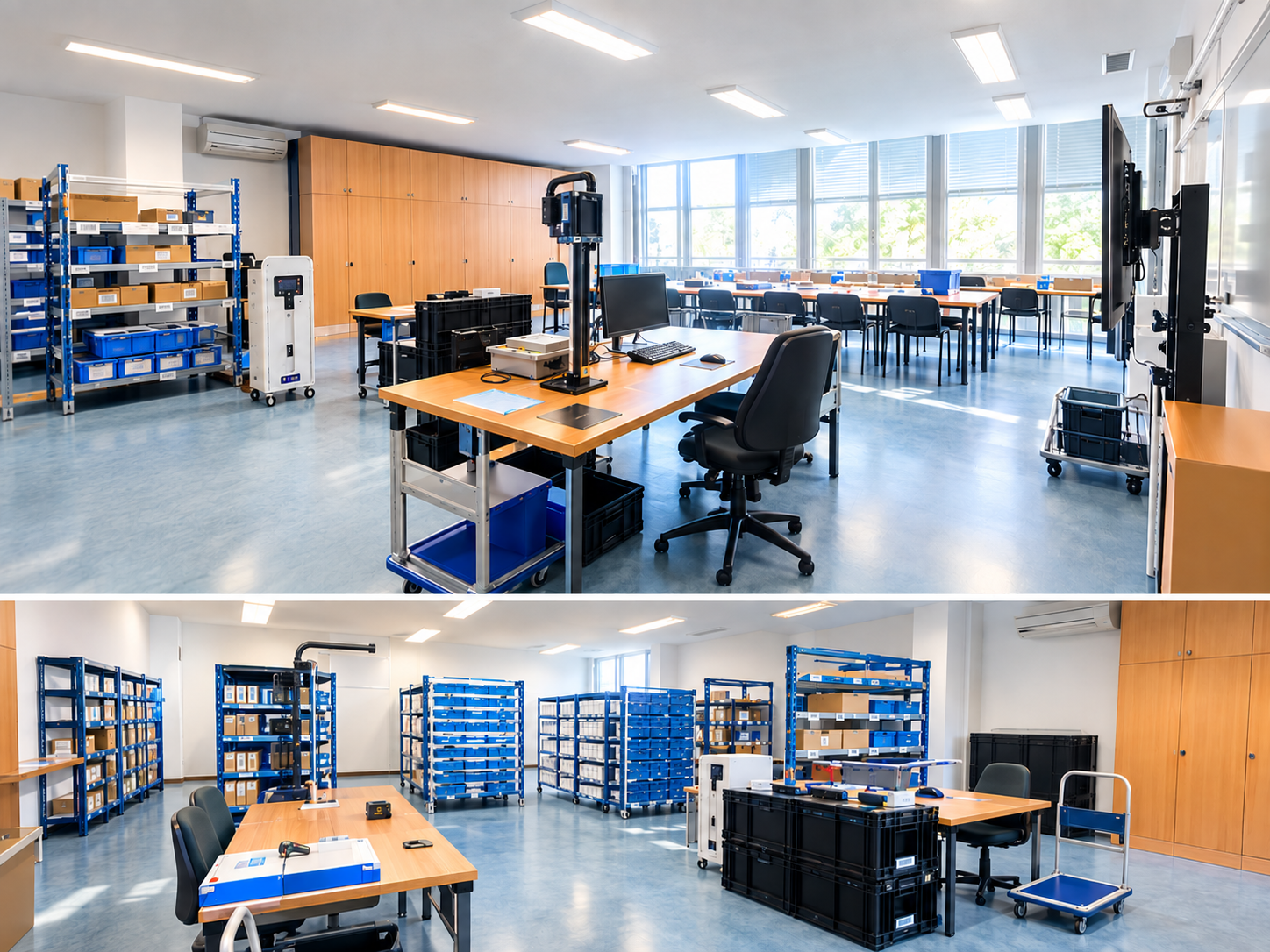


The “SCM Living Lab: Integration of Serious Games, Logistics Operations and Data Analytics for Experiential Learning” project, proposed and coordinated by Pedro Espadinha da Cruz, Assistant Professor at NOVA FCT and UNIDEMI researcher, was one of seven projects selected for funding under NOVA FCT’s pedagogical innovation initiative, receiving €1,000 to support its implementation.
As part of the development of the SCM Living Lab, the project aims to create an experimental environment that brings learning and data analysis closer to the operational reality of supply chains.
Supported by the EQUIPAR+2 – UID.PRR2 UID/PRR2/00667/2025 programme and by UNIDEMI, the infrastructure combines logistics operations — such as receiving, warehousing, picking and shipping — with identification and traceability technologies, information systems, data analytics, simulation and decision-support tools.
The funding awarded will support the implementation of the first activities, including the acquisition of materials such as modular boxes, dummy stock, barcode and RFID labels, and 3D printing filaments.
The first uses of the SCM Living Lab are planned for the 2026/2027 academic year, within the Logistics and Supply Chain Management courses at DEMI.
In the medium term, the infrastructure is expected to support other areas of Industrial Engineering, bringing together teaching, research and collaboration with the business community. As an experimental research infrastructure, the SCM Living Lab will enable the study of the integration between physical processes, digital technologies, data and decision-making, and how this integration can bridge the gap between analytical models and operational reality. Data generated through real operations conducted in the laboratory can then support the development, testing and validation of technologies, analytical models, methods and decision-support systems for logistics and industrial systems.